Natural product peptides such as vancomycin and nisin A owe much of their biological potency to multiple interlocking macrocycles. Each additional ring can restrict the conformational entropy cost of binding, reduce off-target promiscuity, and shield amide bonds from proteases. The PCSK9 clinical candidate MK-0616 illustrates the payoff: a monocyclic mRNA-display hit was progressively reinforced with two further cross-links, ultimately yielding an orally available, highly potent drug. Encoding that level of structural complexity directly into a genetically displayed library would in principle compress the discovery timeline, but producing tricyclic peptides as single regioisomers at the nanomolar concentrations inherent to mRNA display has proved an unsolved challenge. Isomer mixtures arising from non-equivalent reactive sites obscure hit identification and complicate downstream development.
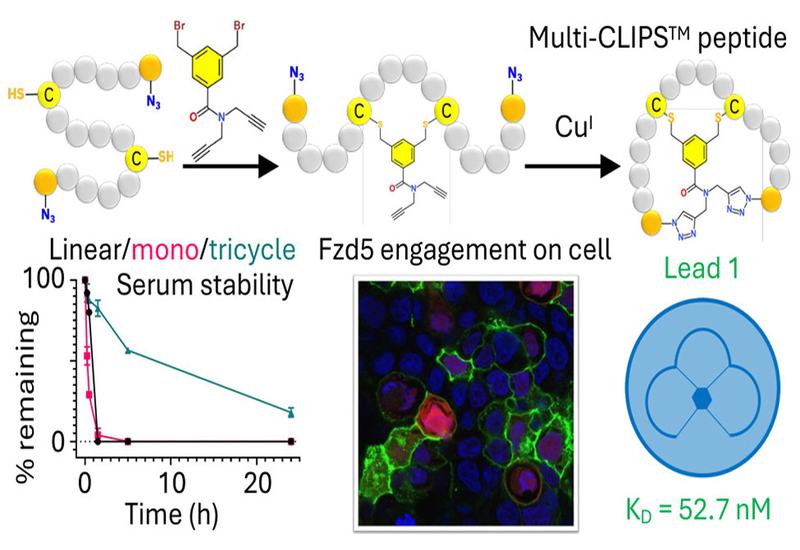
Researchers in the Jongkees Group at Vrije Universiteit Amsterdam and the Timmerman Group at Biosynth, published in ACS Chemical Biology, combined two orthogonal cyclization chemistries on a single aromatic scaffold to address this problem. The tetrafunctional scaffolds, designated type 1 and type 2, carry benzyl bromide groups that react selectively with cysteine residues via CLIPS chemistry, while two alkyne arms react with azidohomoalanine, Azh, residues incorporated by methionine-codon reassignment, via copper-catalyzed azide-alkyne cycloaddition, CuAAC. Crucially, the scaffold retains sufficient rotational freedom after the first cyclization to ensure that the second ring closure produces a single, well-defined tricyclic topology rather than a mixture of isomers. The team validated reaction completion by LC-MS on synthetic peptides spiked into translation mixtures and by pulse-chase biotinylation assays on mRNA-displayed peptides, then applied the chemistry to a randomized three-loop library screened against two structurally distinct model targets.
Against the extracellular cysteine-rich domain of the Frizzled-5 receptor, Fzd5, tricycle 1a emerged as the lead binder, with a KD of 52.7 nM measured by grating-coupled interferometry. A scrambled-sequence control showed no detectable binding, confirming sequence specificity. The monocyclic CLIPS precursor of 1a, produced without CuAAC cyclization, bound Fzd5 with more than 40-fold lower affinity, directly quantifying the contribution of the additional rings. Three loop-replacement variants, each with one loop substituted by GGGG, each lost measurable affinity, and a control peptide carrying only the central CLIPS-cyclized loop also showed no binding, establishing that all three loops contribute to target recognition. Tricycle 1a further engaged Fzd5 overexpressed on live cell surfaces, detected by streptavidin-Alexa Fluor 488 labeling of a biotinylated version of the peptide.
Against the anti-human-CCR7 monoclonal antibody mAb197, for which the three-residue binding motif (F/I/L/M/Y)-A-E was known from prior work, the team identified tricycle 3a with a KD of 460 nM. Replacement of Ile-8 with norleucine and Ala-9 with 2-aminobutyric acid improved affinity 3.2-fold to a KD of 142 nM for variant 3f, roughly five-fold better than a bicyclic comparator from earlier unpublished work. Serum stability assays reinforced the value of full tricyclization: tricycle 1a retained approximately 50% intact peptide after 10 hours in human serum and remained the major component after 24 hours at room temperature, while both the linear and monocyclic controls disappeared within one hour.
The work establishes that rotationally flexible tetrafunctional scaffolds can resolve the regioisomer problem in genetically encoded tricyclic peptide libraries at the dilution demanded by mRNA display. The approach yields hits with low nanomolar affinity, demonstrated three-loop target engagement, and serum stability far exceeding that of monocyclic analogs, all without requiring post-selection medicinal chemistry to introduce the additional constraints. The authors note that type 2 scaffold tricycles suffered from poor aqueous solubility in several cases, identifying scaffold design as a variable for further optimization. Because tricyclization improvements translate directly to clinically validated precedents such as MK-0616, the strategy positions early-stage discovery hits closer to developability thresholds from the outset.